


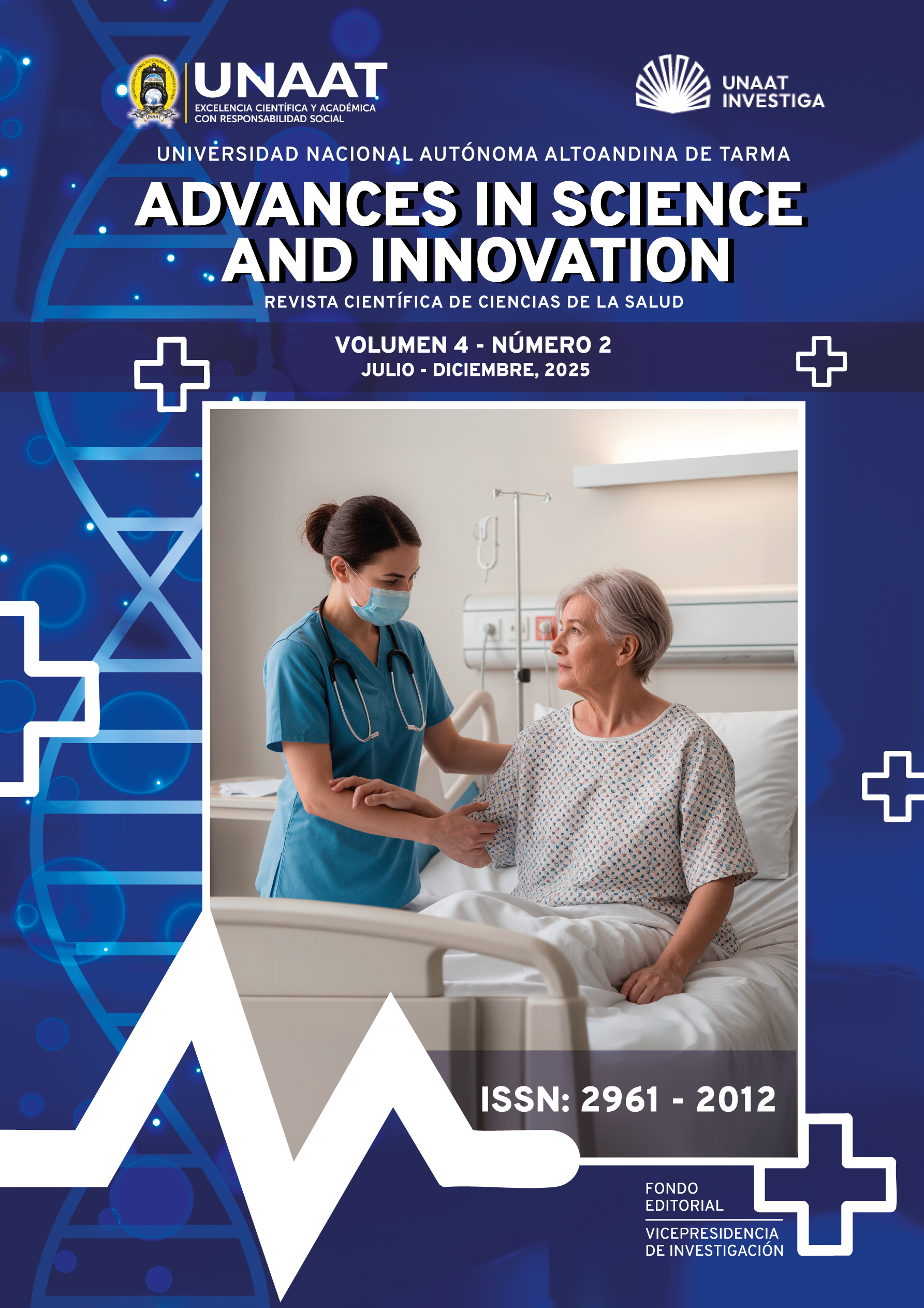
Perspectivas del rol de enfermería en cuidados paliativos: una revisión integrativa desde la epistemología del dolor Perspectives on the role of nursing in palliative care: an integrative review from the epistemology of pain
Article Sidebar
Main Article Content
Abstract
This study aimed to critically examine nursing practices, perceptions, and contributions to pain management in palliative care. An in-depth search was conducted using the PICO structured approach in the Scopus, ScienceDirect, and SciELO databases. Boolean operators and pre-specified inclusion and exclusion criteria from the PRISMA flowchart were used. The results were analyzed based on the integrative synthesis proposed by Whittemore et al. The review reveals that nursing is central to palliative care as an active agent of care, extending beyond the pharmacological management of pain. Its involvement combines technical care with a holistic view of suffering and the ethical mediation required to inform clinical recommendations. Systematic pain assessment, committed communication with patients and families, and the integration of techniques with complementary technologies will remain critical for fostering autonomy, well-being, and continuity of care. Through the epistemology of pain, it is concluded that nursing care emerges as a reflective practice that enhances our understanding of suffering beyond biological dimensions. Therefore, it positions nursing as an epistemic-humanistic discipline, where the professional plays a crucial role in preserving dignity, alleviating suffering, and constructing shared meanings that improve the quality of comprehensive care provided in the palliative care process.
Article Details

This work is licensed under a Creative Commons Attribution 4.0 International License.
References
Aldridge, D. (1993). Esperanza, sentido y terapias de artes creativas en el tratamiento del SIDA. Recuperado el 01 de octubre de 2025, de https://doi.org/10.1016/0197-4556(93)90060-F
Araujo, G., & Uchicawa, K. (2010). terility Maintenance Assessment of Moist/Wet Material After Steam Sterilization and 30-day Storage. Recuperado el 1 de setiembre de 2025, de https://doi.org/10.1590/S0104-11692010000400018
Batista, J., & et. al. (2017). Ortotanásia nas unidades de terapia intensiva: percepção dos enfermeiros. Recuperado el 01 de octubre de 2025, de https://doi.org/10.1590/1983-80422017251177
Borghi, C., & et. al. (2014). Vivir con el dolor: la experiencia de niños y adolescentes en cuidados paliativos. Recuperado el 01 de octubre de 2025, de https://doi.org/10.1590/S0080-623420140000600010
Cant, S., & et. al. (2011). Negotiating competency, professionalism and risk: The integration of complementary and alternative medicine by nurses and midwives in NHS hospitals. Recuperado el 01 de octubre de 2025, de https://doi.org/10.1016/j.socscimed.2010.11.034
Knafl, K. (2005). The integrative review: updated methodology. Recuperado el 01 de setiembre de 2025, de https://doi.org/10.1111/j.1365-2648.2005.03621.x
Miller, M., & et. al. (2023). Spiritual Care as a Core Component of Palliative Nursing. Recuperado el 01 de octubre de 2025, de https://doi.org/10.1097/01.naj.0000919748.95749.e5
Munck, B., & et. al. (2017). The impact of medical technology on sense of security in the palliative home care setting. Recuperado el 01 de octubre de 2025, de https://doi.org/10.12968/bjcn.2017.22.3.130
Phillips, & et. al. (2019). A phase III wait-listed randomised controlled trial of novel targeted inter-professional clinical education intervention to improve cancer patients’ reported pain outcomes (The Cancer Pain Assessment (CPAS) Trial): Study protocol. Recuperado el 01 de octubre de 2025, de https://link.springer.com/article/10.1186/s13063-018-3152-z?utm_source=getftr&utm_medium=getftr&utm_campaign=getftr_pilot&getft_integrator=scopus
Robinson, J., & et. al. (2024). The work of palliative care from the perspectives of district nurses: A qualitative study. Recuperado el 01 de octubre de 2025, de https://doi.org/10.1111/jan.16030
Salzmann, M. (2024). A scoping review of autoethnography in nursing. Recuperado el 01 de octubre de 2025, de https://doi.org/10.1016/j.ijnss.2024.10.002
Simoni, M., & et. al. (2003). Recuperado el 01 de octubre de 2025, de https://doi.org/10.1590/S0103-65642003000200009
Skedsmo, K., & et. al. (2023). Simulation-based learning in palliative care in postgraduate nursing education: a scoping review. Recuperado el 01 de octubre de 2025, de https://doi.org/10.1186/s12904-023-01149-w
Sowicz, T., & et. al. (2022). Pain Management Nurses’ Roles During the COVID-19 Pandemic. Recuperado el 025 de octubre de 2025, de https://doi.org/10.1016/j.pmn.2021.09.006
Venn, S., & et. al. (2024). Non-pharmacological interventions feasible in the nursing scope of practice for pain relief in palliative care patients: a systematic review. Recuperado el 01 de octubre de 2025, de https://doi.org/10.1177/26323524231222496
Wittenberg, E., & et. al. (2024). A conceptual model of the nurse’s role as primary palliative care provider in goals of care communication. Recuperado el 01 de octubre de 2025, de https://doi.org/10.1016/j.pecinn.2024.100254
Zhanette, B., & et. al. (2024). The Impact of Nonpharmacological Interventions on Opioid Use for Chronic Noncancer Pain: A Scoping Review. Recuperado el 01 de octubre de 2025, de https://www.mdpi.com/1660-4601/21/6/794?utm_source=chatgpt.com